Published · 5 min read
QR Code vs NFC Tag: Which Should You Use?
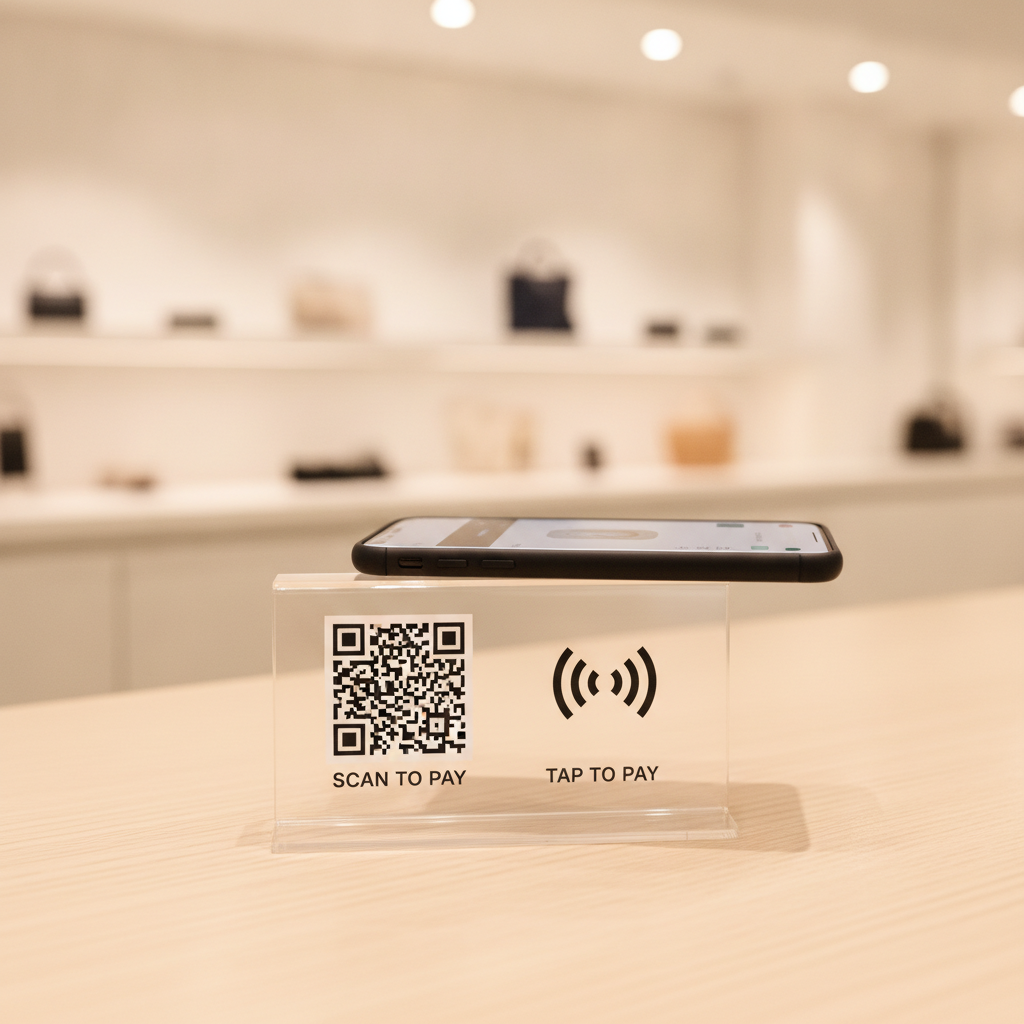
QR codes and NFC tags both get someone from a physical object to a digital destination, but the mechanism — and the trade-offs that come with it — are genuinely different. One is scanned with a camera; the other is tapped by proximity. That difference in mechanism drives almost every practical decision between them.
How each one actually works
A QR code is read visually — a phone’s camera captures the pattern, decodes it, and navigates to whatever it encodes. It requires line of sight and reasonable lighting, but nothing beyond a camera, which every modern smartphone has.
An NFC tag communicates by proximity — a small chip embedded in a sticker, card, or product is read when a phone is held close to it, no camera or visual contact required. It requires the phone to have NFC hardware enabled, which is standard on most modern phones but isn’t guaranteed the way a camera is.
Cost and infrastructure
QR codes are effectively free. Generating and printing one costs nothing beyond the ink and paper (or engraving) already being spent on the object it’s printed on. There’s no embedded hardware — it’s pure geometry.
NFC tags have a real per-unit hardware cost. Each tag is a small physical chip that has to be purchased and embedded into whatever it’s attached to, which adds up meaningfully at scale — printing ten thousand QR-coded boxes costs the same as printing ten thousand ordinary boxes; embedding ten thousand NFC tags does not.
This is the single biggest factor pushing most printed, high-volume use cases — packaging, menus, signage — toward QR codes rather than NFC.
Compatibility and visibility
A QR code is visible — a customer can see there’s something to scan, understand at a glance that it leads somewhere, and act on it without prior explanation. An NFC tag is invisible until someone knows to look for it or is told to tap; the interaction has to be actively signposted (a printed icon, an instruction) since there’s nothing to see on the object itself.
A QR code only needs a camera. An NFC tag needs the reading phone to have NFC enabled, which is nearly universal on recent hardware but not something you can assume the way you can assume a working camera.
Durability and rewritability
This is where NFC has a genuine, meaningful edge: many NFC tags can be rewritten after being embedded, changing what they point to without replacing the physical tag. A static QR code’s printed pattern is fixed the moment it’s printed — changing the destination means generating a new code and reprinting, unless it was pointed at a URL you control in the first place (see static vs dynamic QR codes for how to get most of that flexibility from a static code anyway, at zero ongoing cost).
Physically, a well-embedded NFC tag can also be more resistant to the kind of surface damage — scratches, fading, glare — that affects a printed QR code’s scannability, since the chip itself isn’t read visually. This matters more for extreme environments than for typical print use cases, where a correctly sized, high-error-correction QR code already handles most real-world wear. See error correction levels explained for how much damage tolerance a well-generated QR code actually has before NFC’s durability edge becomes the deciding factor.
When to choose which
Choose a QR code for nearly everything printed once and meant to last: menus, packaging, business cards, signage, asset labels. It’s free, visible, and universally scannable with just a camera.
Choose NFC when you specifically need a rewritable tag at a scale where the per-unit hardware cost is justified, or when tap-based interaction (rather than requiring a customer to open a camera app) is a meaningful part of the experience — contactless payment terminals being the most familiar example, though that’s a purpose-built system rather than a general-purpose tag.
For the overwhelming majority of print use cases this site covers, a QR code’s zero hardware cost, universal camera compatibility, and visible affordance make it the more practical default — NFC earns its cost in narrower, specific scenarios.
Quick reference
- Cost: QR codes are free to print; NFC tags have a real per-unit hardware cost
- Compatibility: QR needs only a camera; NFC needs NFC hardware enabled
- Visibility: QR is visible and self-explanatory; NFC is invisible without signposting
- Rewritability: NFC tags can often be rewritten after embedding; a static QR code’s pattern is fixed once printed
- Default choice for most printed use cases: QR code
Generate a free, permanent QR code — no hardware cost, works with any smartphone camera, no expiry. → Create yours with EtchedQR
For QR codes vs barcodes, see QR code vs barcode. For static vs dynamic, sizing, and every use case, see QR codes for print: the complete guide.